Operationalizing AI Literacy.
AI governance in education only holds if the institution underneath it is AI literate, and that literacy is a set of working competencies to be built, tested, and maintained, not a phrase to be put in a policy.
Some of the most popularized technology in education now comes equipped with AI functionality. I want you to think of AI like part of the ground. The ground under us is not one solid surface. It is a set of rigid plates in constant, slow motion, locked at their edges by friction. The movement never stops. We don’t feel it, because stress accumulates invisibly while the surface appears fixed, until the fault slips and releases all of it at once. This is not something that happens to the earth. It is what the earth is. The plates are not an addition to the ground; they are the ground, and their motion is the ordinary condition of standing on it.
That is where AI can now sit in the tools schools run. Not a product added alongside the others, but something working inside the systems already in use: the search box, the learning platform, the student information system, the family messaging tool. It is becoming the substrate rather than a feature on top of it. Much like our wishes for how and when tectonic plates release their stress never reach the plates, institutional governance cannot reach the substrate. And it is constantly moving as it improves and changes, on a schedule the district has no control over, under policies written while the ground was assumed to be still.
This means the ground now comes with new risks, present at all times and finding new paths to wreak havoc. This is the stress release, and there appears to be far less time between these releases than between the earth’s. All we can do is prepare. Preparation means understanding the ground and continuously studying it as shifts continue beneath us. This is the only way we can keep our feet on solid ground (no pun intended). We must do so, however, as an institution. The term that has been coined to cover this preparation is AI literacy.
What does it mean when an institution is AI literate? How does this literacy show up in governance? The term carries the often hollow ring of “human in the loop.” Think AI governance policies written by an LLM, and not read by the human who wrote the prompt. Without care, the term merely names a desirable state and specifies no operations for reaching or detecting it. That is the structure of a platitude: a claim no one disputes, which obligates no one to do anything, and which no case can ever falsify.
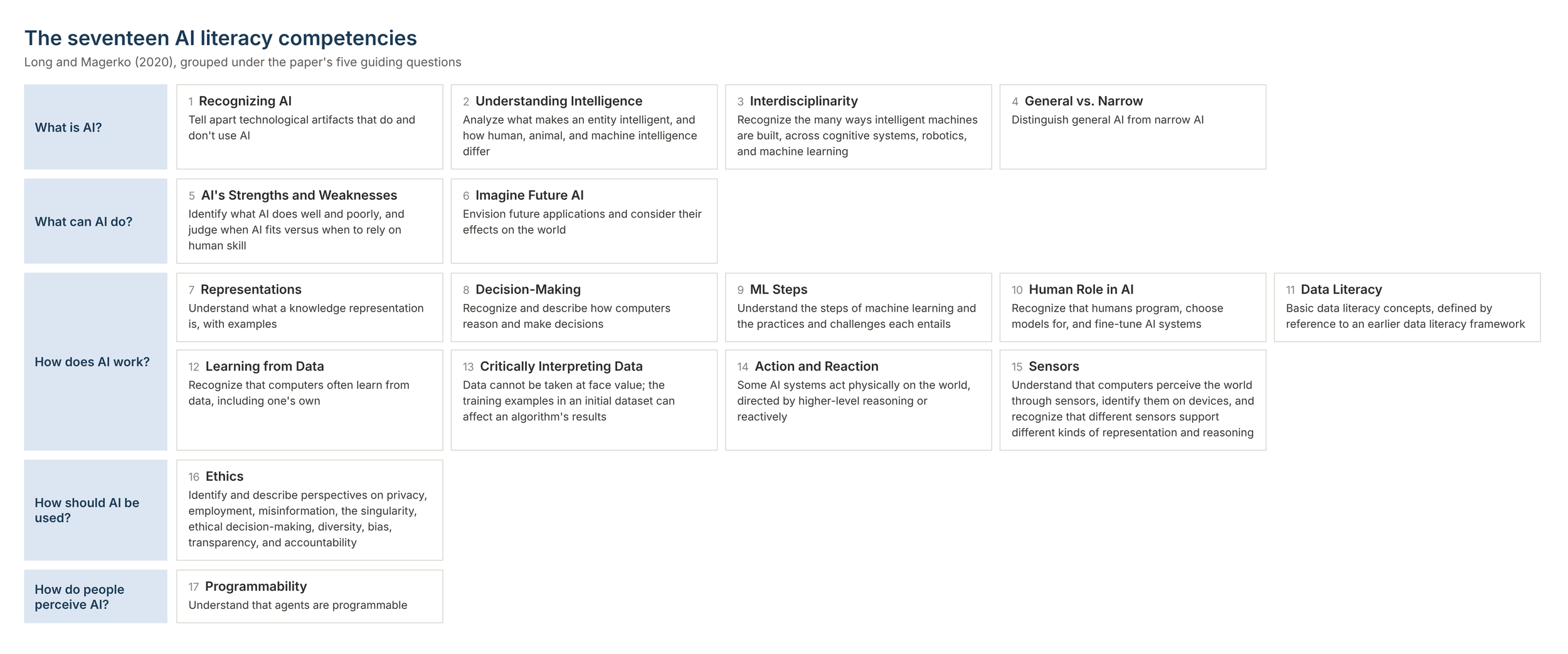
We have sound starting points to avoid this risk. The most-cited definition is Long and Magerko’s (2020): AI literacy is “a set of competencies that enable individuals to evaluate AI technologies critically; communicate and collaborate effectively with AI; and use AI as a tool,” across seventeen competencies (see Table 1). Ng et al. (2021) offer a competing four-part structure: know and understand, use and apply, evaluate and create, and ethical issues. The reality is that while we should all have some level of this AI literacy, different job functions require different levels of understanding. That is part of why some definitions of the term stay vague: they have to stretch across all of those roles.
Table 1: The Seventeen AI Literacy Competencies
Long and Magerko noted in their work that their competencies and framework would need continuous work because the technology would continue to change (sound familiar?). For example, I would argue that their competencies should now include something along the lines of “AI Type and Placement.” This is essentially the ability to distinguish the kinds of AI a tool contains (generative, predictive, adaptive, recognition, retrieval), and whether each function is built into the tool or added on top of it.
If AI governance is the structure a district builds on this ground, institutional AI literacy is its foundation: the part engineered to move with the ground instead of cracking when it shifts. A foundation like that is not poured once and forgotten. It is surveyed, tested, and reinforced as the ground keeps moving. That takes continuous learning, sound judgement, and deliberate application. In a word, operationalization. Operationalizing institutional AI literacy is what lets governance stand on ground that will not hold still. It is from this foundation that job function-specific AI literacy operationalization must be engaged.
In measurement, to operationalize a construct is to define it by the specific, observable operations used to detect and measure it. The construct stops being an idea people discuss and becomes a procedure people run. Intelligence became IQ scores on administered instruments. Poverty became a threshold against a defined income basket. Each definition is arguable, as an operational definition can be criticized, revised, and tested against cases, because it says exactly what it counts.
Education already knows how this works. Reading literacy is not a disposition toward books. It was operationalized decades ago into decoding, fluency measured in correct words per minute, and comprehension on passages at specified complexity. That operationalization is why reading can be taught to criterion, assessed, intervened on, and audited. Remove it and “reading literacy” becomes a sentiment. A literacy claim is operational when it names three things: an observable skill, a way to test for it, and a decision that fails without it. And much like reading literacy, AI literacy could do well with agreement on what said literacy looks like when the practice has to be put to the test. This is also why the practice calls the skillset a competency rather than simply literacy: called a literacy, the actual work gets routed to a professional development day and often dies there (we all know it). An institutional competency puts us all on the hook to maintain the skillset as a function of our jobs. The boards, the administrations, the educators, the education staff. All of us.
Why this is the cornerstone
Every governance instrument a school uses makes claims about a system. A policy describes functions. A data agreement describes processing. A procurement specification describes what is being bought. A letter to families describes what has changed. Each of those is only as sound as the characterization underneath it, and the characterization is the part no one has been assigned.
That is what makes this foundational rather than specialized. The common answer is that it belongs to IT, and that answer is part of why the gap persists. IT holds the admin console, which is one piece of it. The rest is exercised by people who do not work in IT and have not been asked.
Table 2: The Four Desks
Follow any single tool across those four desks. IT can execute only the settings the vendor chose to build. The business office holds an agreement signed years ago that describes an earlier version of the product. The board drafts policy in categories the product may not expose. Teachers build lessons on features that can change underneath them between semesters.
No one in that chain acted carelessly. The capability did not exist at any point in it, so the work fell into the spaces between four roles that each had reason to assume another one held it.
This is also why the answer is not a new office or a single hire. One expert inside IT produces advice that arrives after the board has voted and after the business office has renewed. The skills have to be distributed, at different depths, to each of the four. A board member does not need to operate an admin console. A board member needs to know whether the category the policy names is one the product actually exposes as a setting, and to ask before the vote.
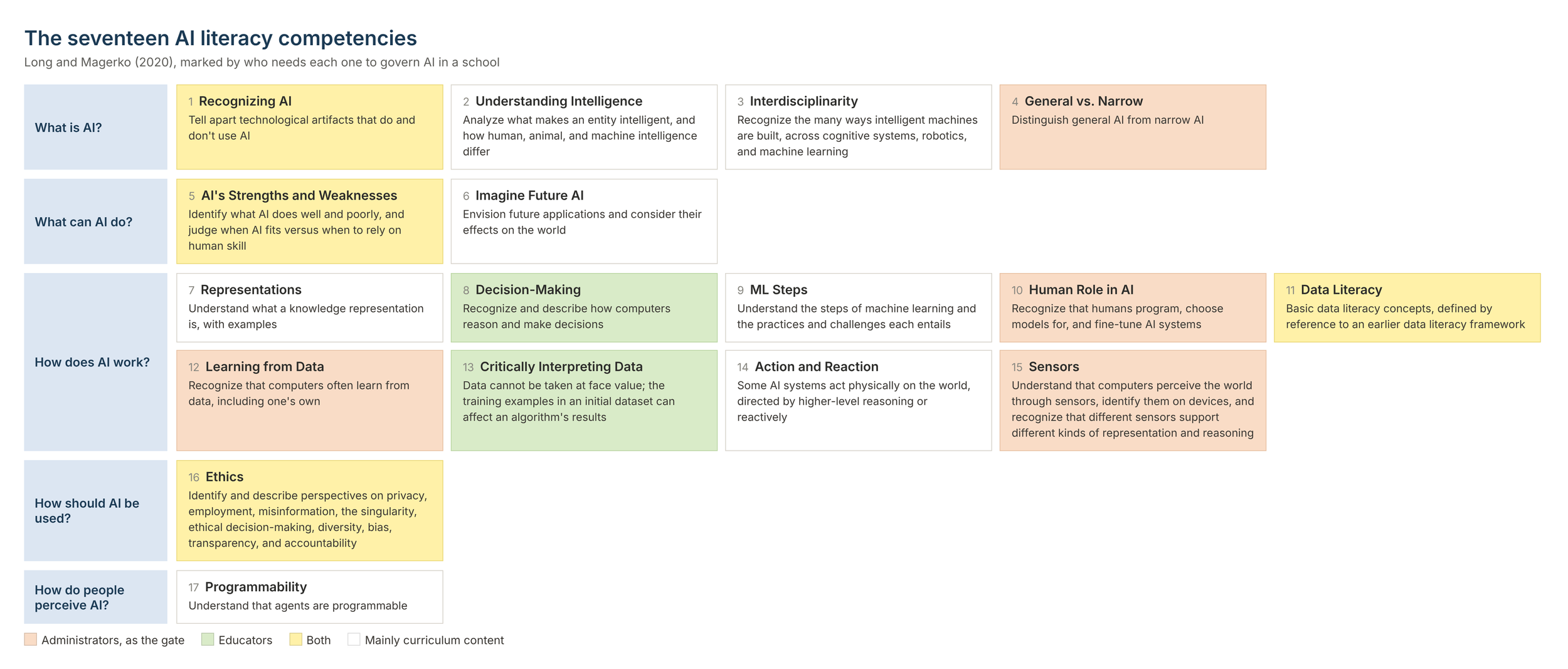
Marked against the full list, that distribution of responsibility could look like this:
Table 3: The Seventeen AI Literacy Competencies Per Role
Distilled to what the institution needs first, seven competencies remain, renumbered as a list of their own: six adapted from Long and Magerko, one proposed.
Table 4: The Institutional Core
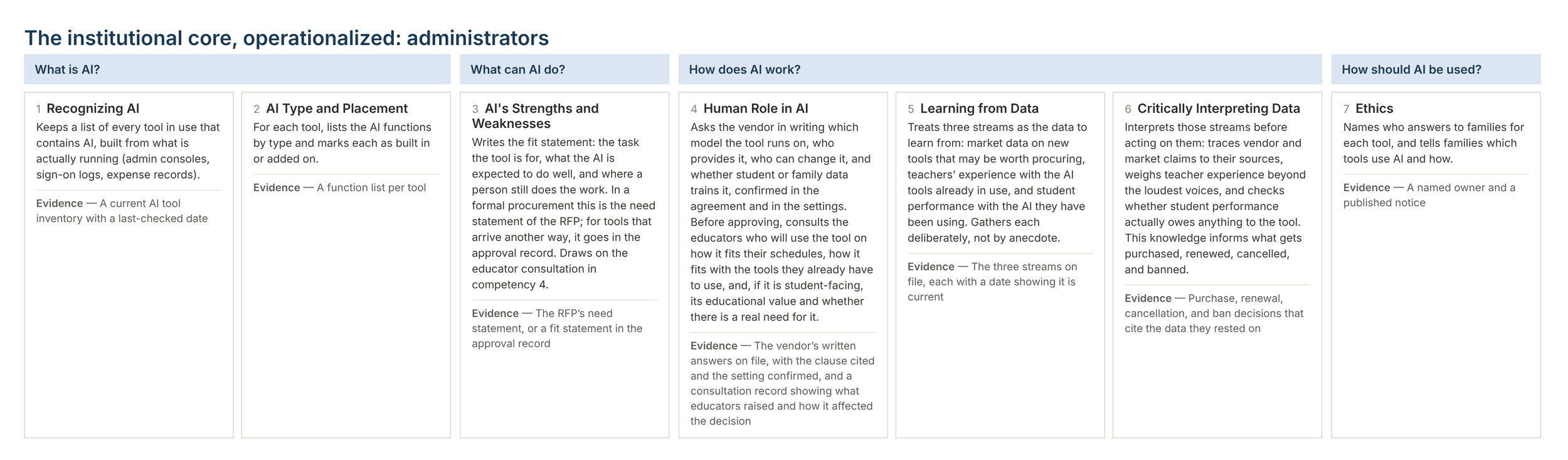
And operationalized at the gate, each one names what the administrator does and the evidence that it was done.
Table 5: The Institutional Core, Operationalized- Administrators
We have a conversation starter on what operationalization could look like. We have a base for skillsets to be named, grown, tested, argued, and revamped. What does this operationalization process look like for the educator? How is it utilized to teach the student, both overall and about AI? The clarity brought about by solidifying this foundation will lead into integration of AI that is worthwhile. Integration that clears the educator’s plate to make room for their actual teaching expertise, their deep context of their subject areas, and their tested judgement.